
How to Choose the Right Chimney Cleaning Company in Bensonhurst
Most homeowners pick a chimney company the way they pick a pizza place: whoever answers the phone first and quotes the lowest number. That works fine for dinner. For the venting system attached to a wood-burning fireplace in a century-old Bensonhurst row house, it’s how people end up paying twice. The right choice comes down to three things you can actually verify: who is standing on your roof, what equipment they carried up there, and whether the company can fix what the inspection finds.
If you’d rather skip the vetting and talk to someone now, call (855) 924-3713. We answer 24/7, with fast dispatch from 7am to 7pm, Sunday through Friday.
Key Takeaways
- A CSIA-certified company and a CSIA-certified technician are not the same thing. Ask which individual will be on-site.
- A full-lifecycle chimney company covers five categories: sweeping, inspection, cap and crown work, chimney repair, and fireplace repair.
- Ask whether a rotary cleaning system and a video inspection camera ride on the truck by default, not on request.
- A verbal “you’re all set” after a sweep is not an inspection. You want a written report with photos and dimensioned findings.
- Older Bensonhurst row homes with shared flues need someone who knows multi-wythe brick, not just prefab chase work.
What’s the Difference Between a CSIA-Certified Company and a CSIA-Certified Technician?
They’re different credentials, and the gap matters. A company certification means the business has met the Chimney Safety Institute of America’s standards at the organizational level. A technician certification means that specific person passed the CSIA exam and holds the credential in their own name. One does not guarantee the other. A company can hold certification while sending an uncertified helper to your roof, and plenty do.
So when you call around Bensonhurst, don’t ask “are you certified?” Ask “who will be at my chimney, and is that person CSIA-certified?” A straight answer comes quickly. A shuffle toward “our team is fully trained” tells you something too.
This is the floor of the conversation, not the ceiling. Certification confirms baseline competence in sweeping and inspection. It says nothing about whether the company can reline a flue, pour a crown, or resurface deteriorating liner walls. Those are separate skills backed by separate training and separate material systems, and a certified sweep can still be a one-task operation. The credential gets a company into the room. What they can do once they’re there is the real question.
What Five Capabilities Should a Full-Lifecycle Chimney Company Have?
A company built for cleaning alone will hand you a list of referrals the moment the inspection turns up a problem. A full-lifecycle company resolves all five categories in one relationship:
- Sweeping. Removal of creosote, soot, and obstructions from the flue. The baseline service, and the one most companies stop at.
- Inspection at the right level. Level I for an annual check of an accessible, unchanged system. Level II when a home changes hands, an appliance changes, or a problem is suspected, and it requires video scanning of the flue interior. Level III when conditions demand opening up concealed areas of the chimney structure.
- Liner work. Relining a flue with a flexible stainless system, or restoring cracked and spalling liner walls with a ceramic resurfacing method. This is where capability gaps show up fastest.
- Crown and cap installation. The concrete crown at the top and the cap over the flue are the chimney’s first defense against water, and water is what quietly destroys masonry.
- Masonry and fireplace repair. Repointing brick, rebuilding a crown, repairing a firebox or damper.
In our experience, the companies that check the first box and skip the rest are the ones that leave Bensonhurst homeowners making three phone calls instead of one. When the inspection finds a cracked liner, you want the same company to quote the reline, not a name scribbled on a business card.
What Equipment Questions Actually Separate Companies?
Equipment is the least romantic question and one of the most revealing. Two pieces of gear tell you most of what you need to know about how a company operates.
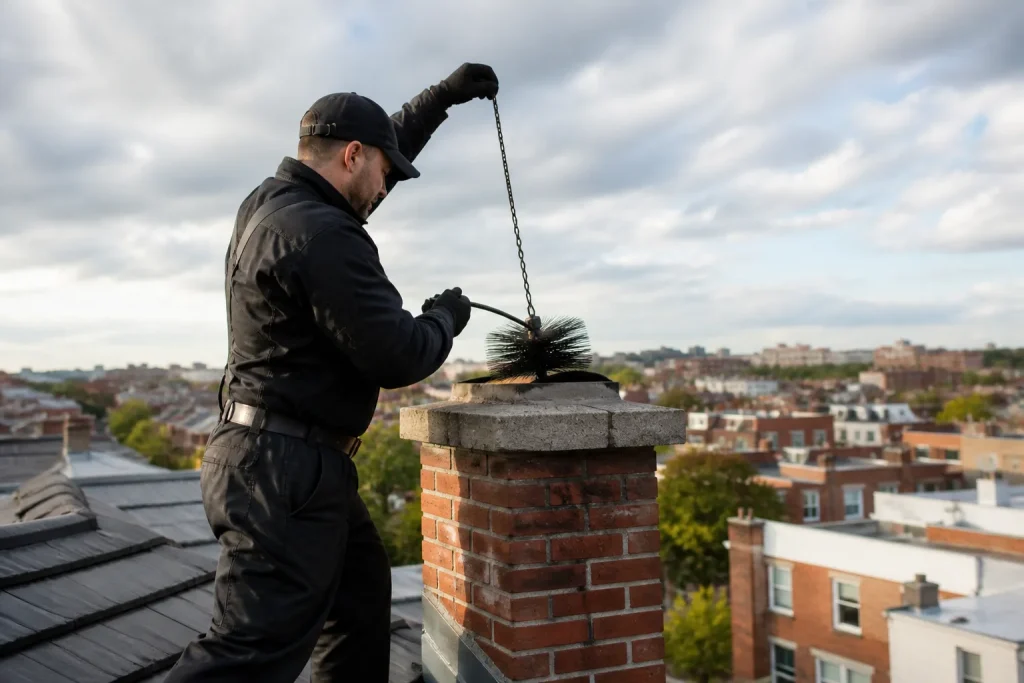
A rotary cleaning system. Modern flues don’t always respond to a hand brush alone. Glazed, hardened creosote needs a spinning whip or chain head to break it down properly. A company working from a brush on a rod can look busy for an hour and leave the worst of it on the wall.
A video inspection camera. The camera is how anyone sees what’s actually happening inside a flue, especially in an older Bensonhurst chimney with offsets, shared flues, or a liner that’s been patched before. Ask this direct question: does the camera ride on the truck for every call, or does it come out only when a customer requests it? A camera that appears on request only means the default visit is a look from the top and a guess about the rest.
One more: what’s in the truck when it arrives? Companies drawing from multiple professional supply lines – Famco, Olympia Chimney, and Copperfield among them – can match a cap or a component to the actual flue dimensions they measure. A company with a single generic parts source fits what it has to what it finds. Those are different outcomes.
What Should a Written Chimney Inspection Report Contain?
The most common letdown in Bensonhurst chimney service isn’t a bad sweep. It’s the walk-away. The technician finishes, says the chimney looks fine, gets in the van. Three months later there’s a water stain on the ceiling and nobody can explain where it came from, because nothing was written down.
A real inspection report gives you:
- Dimensioned findings. Flue dimensions, clearances, and the condition of individual components, not just “chimney in good condition.”
- Photo documentation. Pictures of the flue interior, the crown, the cap, and any cracks, gaps, or creosote buildup. You should be able to see what the technician saw.
- Code and standard references. Findings measured against NFPA 211, the standard governing chimney, fireplace, and venting installation.
- A clear recommendation and a clear “no action needed.” A good inspector tells you plainly when work can wait, and why.
Why this matters: an unscrupulous company can tell you the liner is failing when it isn’t, and you’d have no way to know. A written report with photos is the only defense. It’s also your record for a future sale, insurance question, or comparison with another company’s quote. If the answer comes verbally, ask for it in writing before anyone climbs down the ladder.
Why Bensonhurst Chimneys Need a Company That Knows Older Brick Construction
Bensonhurst isn’t a subdivision of new construction. Much of the housing stock is older attached row homes, and that changes what a chimney visit requires. Row homes frequently share flue systems with a neighbor, or carry flues that a previous owner modified, connected, or capped off in ways nobody documented. A technician who works mostly with modern prefab chase chimneys is on unfamiliar ground here.
Multi-wythe brick construction behaves differently from a thin modern chase. It holds moisture and spalls in its own way, it moves, and it often shows its problems through the crown or through interior staining rather than at the firebox. Reading those signs takes familiarity with brick of that era, not just a flashlight aimed at the flue.
Sweeping an older shared flue also demands care. An aggressive rotary pass on a flue that wasn’t built for it can do real damage, which is why a Level II video inspection often comes before the cleaning on a first visit to an older Bensonhurst home. When a company quotes a sweep sight unseen on a brick row house, ask whether they’ll scope it first. The answer tells you who you’re dealing with.
When to Call a Pro
Routine sweeping is the easy call. These situations shouldn’t wait for a convenient week:
- You smell smoke in the room with the damper open, or the fireplace backdrafts when you light a fire.
- There’s a strong, pungent odor from the firebox on warm days, which can point to creosote or drafting issues.
- You see water staining on the ceiling near the chimney or crumbling at the crown.
- The firebox or damper is damaged, or you’ve never had the chimney looked at since buying the home.
- You burn wood and it’s been more than a year since the flue was cleaned.
We can take care of all of it, from the annual sweep to the masonry work. If you need the cleaning itself, our chimney sweep page covers what a visit involves. If the crown or cap is the issue, that’s handled under chimney cap & crown. For brick work, a leaking flue, or a damaged firebox, start with chimney repair. And for the full picture of how we approach chimney care, see our Chimney Sweep Bensonhurst page.
The Bottom Line
Choosing a chimney company in Bensonhurst comes down to a handful of questions you can ask on the phone and answers you can verify afterward. Ask who is certified, not just whether the company is. Ask whether every visit includes a scope camera and a written report with photos. Ask what the company can fix on-site instead of referring out. Companies that get those questions right are usually the ones that get the chimney right.
Whether it’s a routine sweep, a Level II inspection, a reline, or a crown rebuild, one call covers it. If you’re in Bensonhurst and need help, Chimney Sweep Bensonhurst offers free estimates. Call (855) 924-3713. We answer 24/7. Fast dispatch from 7am to 7pm, Sunday through Friday.
Frequently Asked Questions
Ask whether the individual technician coming to your home holds CSIA certification in their own name, not just whether the company holds it. Then ask about equipment: a rotary cleaning system and a video inspection camera on the truck for every visit. Finally, ask for the written inspection report sample in advance, so you know what findings and photos you’ll receive. Call (855) 924-3713 and we’ll answer all of it directly.
Level I is the annual check of an accessible, unchanged system, usually with the standard tools and a look at the visible portions. Level II goes further and includes video scanning of the flue interior, required when a home changes hands or an appliance changes. Level III involves opening up concealed areas of the chimney structure when conditions call for it. Every level should produce written findings. Call (855) 924-3713 for an exact quote on your inspection.
Usually not. Basic sweep crews clean and inspect; liner relining, ceramic flue resurfacing, and crown rebuilds require separate training and specialist materials. We work with professional-grade systems including DuraFlex flexible liners and HeatShield ceramic flue resurfacing to cover those repairs in-house, so a scope finding doesn’t turn into a referral and a second appointment. Call (855) 924-3713 to discuss your chimney’s specific condition.
Once a year for homes that burn wood regularly, and sooner if you notice smoke backing up, a strong odor from the firebox, or a buildup of creosote on the flue walls. Gas fireplaces still need an annual inspection even without wood soot. An older brick row home benefits from a video scan on the first visit, since prior modifications are hard to see without one. Call (855) 924-3713. We answer 24/7, with fast dispatch from 7am to 7pm, Sunday through Friday.
Written by the team at Chimney Sweep Bensonhurst.
Need Chimney Cleaning Help?
Call Chimney Sweep Bensonhurst - the local pro we connect you with is licensed and insured, with free written estimates in Bensonhurst.
(855) 924-3713